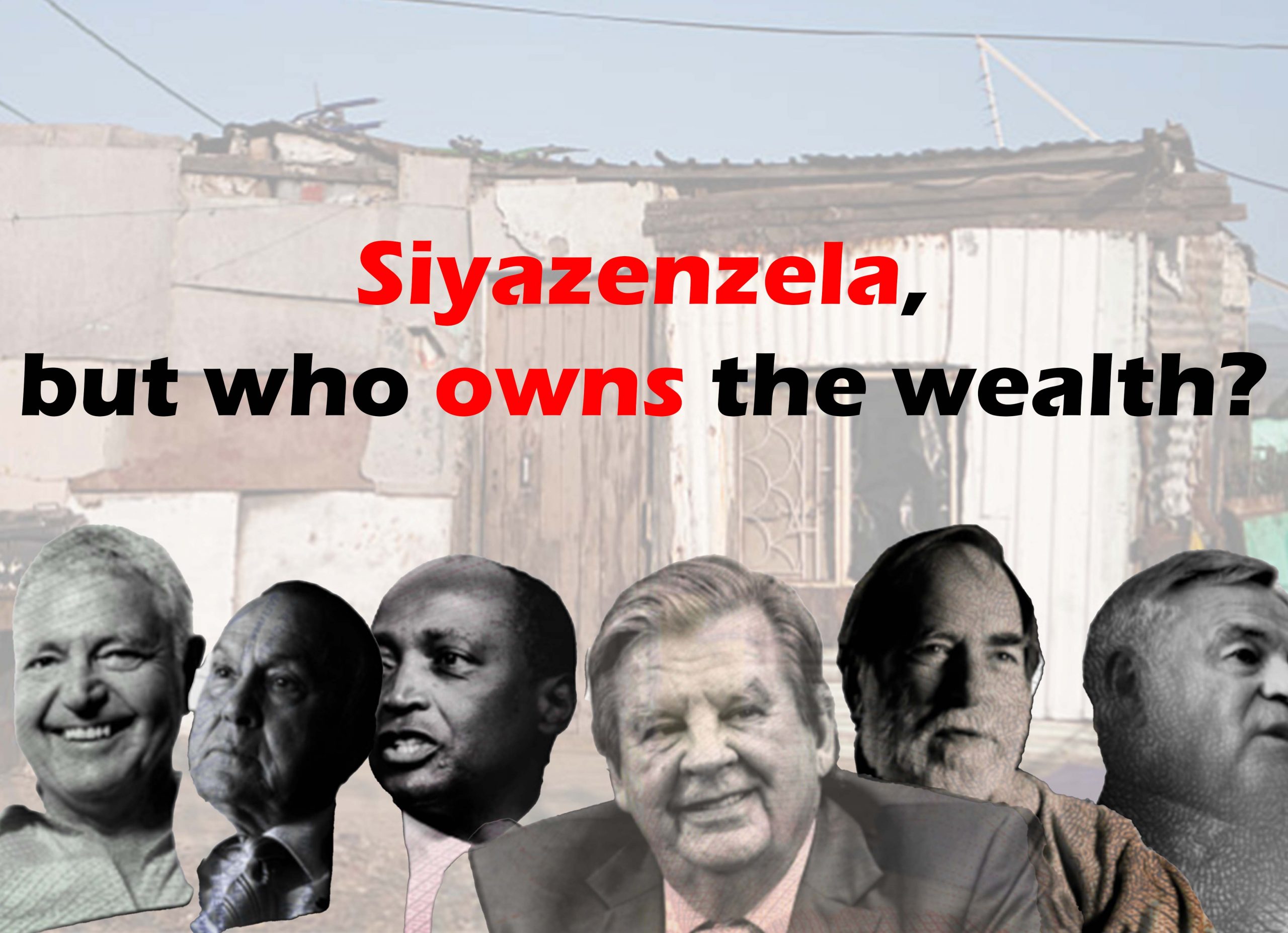
Siyazenzela, But Who Controls the Wealth?
Mbuyiseni Ndlozi, popular power and the unfinished revolution
Mosa Phadi and Luke Sinwell
We are now living what was once only fiction to our imagination. When we first read Chinua Achebe’s 1958 novel, few of us believed that its events would be experienced in South Africa. Today the reality is clear: “Things are fall[ing] apart.” Solutions remain far from reach. Yet the fear of the fall, and the urge to break it before it crushes us, has produced several proposals for how to catch us before we hit the floor.
Mbuyiseni Ndlozi is one of many voices echoing Achebe, and he proposes what he calls the 11 Theses on the Call for Batho Pele Convention: Siyazenzela. Written in an almost biblical prose, the theses follow a well-established tendency within the Black intellectual tradition: an appeal to “collective self-sufficient action”, and to the duty that Black leaders and intellectuals owe their people, so that freedom can be imagined and felt by all. These ideals sit squarely within certain logic of the Black imagination of freedom of self-reliance. Ndlozi goes a step further, calling for a “return to Material Autonomy, a membership-funded” movement, for the inculcation of radical self-love and for adherence to the Constitution. Self-sufficiency, citizen agency and Pan-Africanism, he argues, will lead us to claim the state. For now, however, the theses must be enacted “in your homes, streets, workplaces and places of worship”.
His call for active citizenship, community organisation and crowdfunding speaks to a real failure of post-apartheid democracy. People are expected to vote every five years, while decisions about their lives are made elsewhere. Communities are treated as audiences for political promises rather than as collective agents capable of determining their futures. Ndlozi wants to reverse this relationship. That is an important starting point. The question, however, is whether Siyazenzela can become more than a way of surviving the failures of the existing order.
The contradiction is historical. Under apartheid, the state was an instrument of racial domination, and Black people were excluded from political power. The democratic struggle sought not merely the right to vote, but the transformation of the institutions and material relations that reproduced racial oppression. In 1994, political power changed hands, but ownership of the economy did not change to the same extent. Black people gained democratic ownership of the state without gaining equivalent control over capital, investment and productive wealth.
The unfinished task of liberation is to turn political ownership into popular power and democratic control of the state into the power to transform the economy.
Crowdfunding offers one answer at the level of immediate need. Communities can raise money to repair schools, support learners and fund projects that bring visible, material improvements to people’s lives. These initiatives can rebuild solidarity and demonstrate that ordinary people need not wait for permission to act.
But a community that raises money to repair a school is not the same as a society that controls the resources required to educate every child. Crowdfunding can mobilise resources; it cannot, by itself, redistribute them. Poor communities cannot fund their way out of an economic structure that concentrates wealth elsewhere.
The selflessness Siyazenzela calls for, moreover, arrives at the very moment when the forgotten need the state more than ever. The call to abandon the state, even momentarily, and to focus on our individual and collective selves assumes that such self-help has been the practice of the poor and working class. Sarah Mosoetsa has devoted a whole book, Eating from One Pot, to capturing, in the most beautiful ways, how poor households pool what little they have to survive. These communities are now being told, once again, to abandon a state that was absent from the beginning.
Here lies the danger: Siyazenzela could become a form of privatised self-help, with a collective and progressive face, if communities are encouraged to finance their own development while the distribution of wealth and the power of capital remain intact. The language of empowerment can then obscure a transfer of responsibility from public institutions to those least able to bear it. White monopoly capital need not be displaced if communities are left to manage the consequences of its continued economic dominance.
The alternative is not to abandon community initiative, but to radicalise its political meaning. During the anti-apartheid struggle, street committees, civic associations and people’s organisations did more than fill gaps in service provision. They challenged who had the authority to govern. Their significance lay not simply in what they provided, but in the popular power they organised.
Today, the task is different. Black people possess democratic rights and vote in a state that formally belongs to the entire public. We cannot simply reproduce the politics of resistance to an exclusionary state. We must develop forms of popular power that transform a democratically constituted state whose institutions and resources remain insufficiently accountable to the majority.
This means democratising the state from below by giving organised communities real power over budgets, planning, procurement and public services. It also means using public power to confront private economic power, redistribute resources, expand universal services and direct investment towards social needs rather than private accumulation. Without that transformation, community projects may alleviate poverty without changing the relations that produce it.
The left must therefore refuse the choice between state power and popular power. A state without organised popular pressure can become distant, bureaucratic and captured by private interests. Popular organisation without a strategy for explicitly confronting state power risks being confined to local projects, perpetually repairing the damage produced by a wider economic system.
Ndlozi’s intervention opens the question of how people can become agents of their own development. The further question is how that agency can reorganise society as a whole.
This, then, is the unfinished task of liberation. It requires more than communities learning to provide for themselves within a system that continues to dispossess them. It requires organised communities capable of determining how public resources are used, confronting the power of capital and remaking the institutions that govern their lives.
The task is not simply to build from below in the shadow of the state, but to build a popular power from below capable of replacing the state and the social relations it upholds. Otherwise, Siyazenzela risks becoming a politics of collective survival rather than a vehicle for building the collective power needed to transform society.